
Delaware County Projected Release Meaning
A projected or tentative release date is an estimate based on the sentence record and the information currently available to the custodian. It may estimate when confinement could end. The actual release date records what happened after the agency completed its process. Final discharge can come later, after parole or another period of community supervision ends.
Pretrial custody follows a different path. A Delaware County Jail detainee who has not been sentenced does not have a prison-style calculated release date. Bond, dismissal, a court release order, case resolution, or a transfer may end the jail episode. Another case, warrant, or detainer can keep the person in custody even after one judge authorizes release.
- Projected date
- An estimate based on current sentence and credit information.
- Parole eligibility
- The earliest point when a person may qualify for consideration, not a promised release.
- Actual release
- The completed custody event recorded by the releasing agency.
- Discharge
- Completion of the relevant correctional sentence or supervision duty.
Find Delaware County Projected Dates
Start with the last known custodian. A person leaving the Delaware County Jail for ODOC has transferred, not returned to the community. State and county sentences also use different record systems. The Delaware County release search can help establish that custody chain before a date is interpreted.
- Obtain the filed judgment and sentence. Note the Delaware County case number, counts, term length, and whether terms run together or one after another.
- Identify the custodian. Use DCSO for a county jail term and ODOC for a state sentence.
- For state custody, search the ODOC Offender Lookup by ODOC number when possible and compare identity, county, case, and offense entries.
- Transcribe each date with its exact label, such as reception, sentence start, projected release, parole, supervision end, or discharge.
- For a county term, ask DCSO for the judgment used, jail-credit total, local computation, and any hold affecting release.
- Confirm an accomplished release through the agency after processing rather than relying on an older projected date.
A name-only match is weak. Compare the ODOC number, date of birth or physical identifiers, Delaware County case, and every sentence row. Concurrent terms run at the same time, while consecutive terms run one after another. Suspended time and community supervision may also appear. If the displayed date has passed but the status remains active, contact ODOC instead of selecting an explanation.
Note: Preserve the source label and access date for every sentence date so projected, parole, release, and discharge milestones remain distinct.
ODOC Delaware County Date Lookup
The official ODOC Offender Information page routes users to the state lookup and explains the limits of offender data. Public records can include identifying information, ODOC number, sentence entries, reception dates, facility or status, and similar fields. A public data download can help with historical research, but it does not replace the current operational record.
Read a facility or location field closely. It can name a prison or a community supervision office. Parole and probation mean the person is outside prison but remains under a legal sentence or supervision. Discharged has a different meaning. A projected field for an active term does not establish either state release or final discharge.
The official ODOC offender lookup screenshot shows the search interface used for a Delaware County state-sentence inquiry.
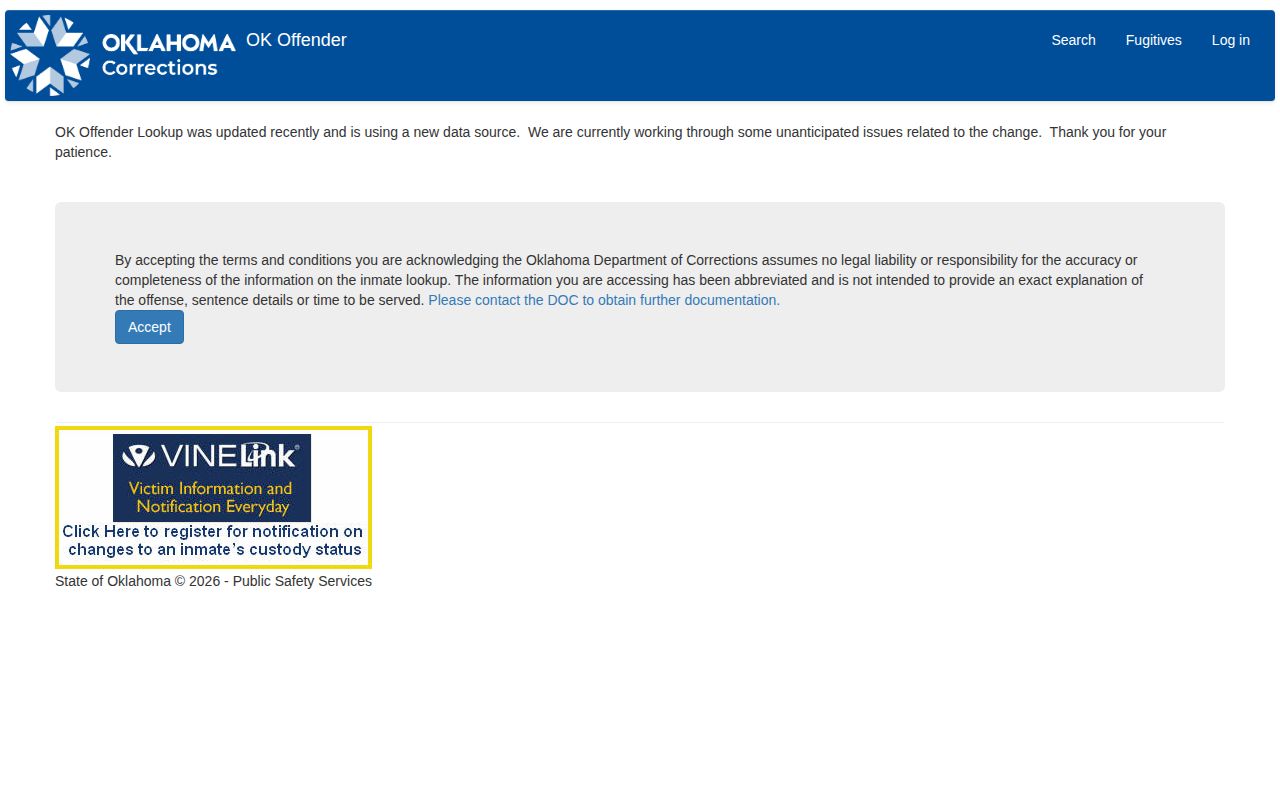
This blank search view teaches access without exposing an individual's record. The live result must supply the exact date label, status, and sentence context for the person being checked.
Oklahoma Credits and Delaware Releases
57 O.S. § 138 establishes Oklahoma's earned-credit structure and class-level accrual. Credits can affect a projected completion date. They depend on statutory and administrative conditions, may be lost for discipline, and may be restored under policy. Achievement credits can also change the estimate. A maximum possible credit rate is never proof that a person earned or retained that rate.
A sound date review begins with the controlling judgment, the offense statute and date, term length, sentence structure, credited jail time, and ODOC's current credit class and history. Jail time recognized before ODOC reception also matters. If a later order modifies, revokes, accelerates, or changes concurrency, that order may replace the assumptions behind an earlier estimate.
Only ODOC Sentence Administration can provide an authoritative current state computation. The statute explains legal credit authority, but it is not a public calculator for one person's release day.
Note: One earned credit generally concerns one incarceration day, but eligibility, class, conduct, sentence limits, and actual awards still control the result.
Delaware County 85-Percent Sentences
21 O.S. § 13.1 applies to enumerated offenses. For a covered conviction, the required portion affects parole consideration and how far credits may reduce imprisonment under the statute. It is offense-specific. It does not mean every Oklahoma prisoner serves exactly eighty-five percent, and an arrest allegation cannot substitute for the final conviction.
Check the statute version effective for the offense date and match the conviction provision in the filed judgment. Parole eligibility under 57 O.S. § 332.7 can also depend on offense date, classification, exclusions, sentence structure, and other minimums. Consecutive terms, life without parole, restricted-credit offenses, and later orders prevent one fraction from producing a reliable calendar date.
A Board docket shows that consideration was scheduled. A results sheet records Board action. Neither is the prison gate date. Pair any parole record with the later ODOC operational status and the releasing agency's record.
Why Delaware Release Dates Change
A projected date is recalculated when its inputs change. Some changes shorten the estimate, while others extend confinement or block release to the community. The agency record, not guesswork, must identify which factor applies to a Delaware County offender.
| Factor | Possible effect | Best confirmation |
|---|---|---|
| Earned or achievement credits | May move the projection under governing rules | Current ODOC computation |
| Misconduct or credit loss | May move the projected day later | ODOC sentence administration |
| Jail credit | Recognized pre-reception time may affect the term | Judgment, credit order, and ODOC |
| Concurrent or consecutive terms | Changes how multiple counts and cases combine | Filed judgment and later orders |
| Detainer or warrant | Can cause transfer or continued custody after one term | Releasing and receiving agencies |
| Parole action | May affect the route from prison to supervision | Board result followed by ODOC status |
| Revocation or new order | Can replace an earlier sentence assumption | Court docket and current agency record |
The court clock and jail clock can differ. A judge may sign an order before jail staff receive it, check holds, and complete processing. If the order date and discharge date differ, report each with its source rather than calling one wrong.
Delaware County Jail Date Computation
County jail calculations should not be copied from the ODOC framework. For a sentenced person at the Delaware County Jail, gather the judgment, commitment date, court-approved jail credit, count structure, and any local computation maintained by DCSO. Ask whether another case, warrant, transfer order, or detainer affects the expected release.
No Delaware County-specific public good-time policy was verified. No public weekend or holiday adjustment rule was found either. Do not assume an expected Saturday or Sunday date becomes an early Friday release. Contact DCSO at 918-253-4530 for the current calculation and request the actual jail-register discharge entry after the custody episode ends.
For a pretrial detainee, avoid a projected-day claim altogether. Bond may be posted, a court may issue an order, charges may change, or another authority may accept custody. Physical release still depends on jail processing and all active holds.
Oklahoma Tentative Release Date Limits
ODOC publicly describes an exact release date as confidential without an appropriate need and characterizes its tentative value as subject to change. The agency specifically identifies earned-credit level, misconduct, and achievement credits as reasons a date may move. That state rule requires care when a Delaware County requester sees an estimate in a public record or hears one from another source.
Keep four milestones separate: projection, parole eligibility, actual release, and final discharge. Projection estimates the sentence outcome. Eligibility permits possible consideration. Release is the completed custody event. Discharge ends the relevant correctional obligation. Combining them into one “release date” can falsely describe both custody and legal status.
When an appropriate current date is needed, identify the purpose and ask ODOC for the authoritative computation through its official record or sentence-administration route. Do not publish a stale screenshot as proof of what later occurred.
Delaware County Parole Date Differences
Parole eligibility does not guarantee a hearing recommendation, approval, a release plan, or release. A Board docket is prospective evidence. A results sheet records a decision-stage event. The later ODOC status shows the operational result, while the agency custody record establishes accomplished release.
A person released on parole has left prison confinement but has not discharged the sentence. The projected prison date, first possible parole-consideration point, supervision start, and supervision end must stay in separate fields. This explains why a person may live in Delaware County while ODOC still lists an active status.
If a Board result and ODOC status appear inconsistent, retain the access dates and ask ODOC which sentence or administrative step controls. Each record documents a different stage.
Confirm Delaware County Actual Release
After the projected day approaches, recheck the current custodian. For state custody, preserve the ODOC status and date labels, then ask ODOC to clarify conflicting terms. For the county jail, call DCSO and request the date and manner of discharge. A transfer must remain labeled as a transfer even though the county roster no longer shows the person.
Oklahoma VINE can alert a registrant to a reported release, transfer, or custody change. The Delaware County VINELink check explains the specific-person search and channel confirmation process. Notifications can lag or fail, so use the alert as a prompt to verify with the source agency.
Court records can confirm legal authority. Read the Delaware County docket around the expected date for a bond order, judgment, sentence, dismissal, revocation, or transport entry. The jail or ODOC record remains the source for physical release. If the systems conflict, record when each was checked and request clarification rather than inferring the outcome. One case's release does not cancel another valid hold.