
Delaware County 72-Hour Releases
No verified DCSO page lists community releases over a rolling three-day span. The current Sheriff roster shows people in county custody and sorts results by booking date. It does not publish a release filter, a refresh schedule, or a period for keeping former inmates online. A reader cannot select the last 72 hours and get an official group of released people.
The wider window is still useful as a records question. It gives time for a weekend, holiday, or late-day event to appear in participating systems. Yet more time does not cure a source mismatch. A booking report is still a booking report, and a current roster remains a current roster. The correct three-day review joins individual custody events instead of relabeling either source.
Check Delaware County 72-Hour Releases
Start with the time range. Write down the beginning and end of the 72-hour period, the last known custodian, the person's name variants, and any case or booking number. This prevents a weekend court event from being confused with a jail event processed on a later calendar day.
- Check the DCSO roster and note the exact time. A current match suggests county custody; an absent name requires more work.
- Search VINELink with Oklahoma selected. Compare the reporting agency, custody status, event, and event date for each possible match.
- Call the Delaware County Jail at 918-253-4530. Ask whether the identified booking ended during the chosen window and whether the outcome was community release or transfer.
- Review OSCN and ODCR by case number. Read bond, dismissal, judgment, revocation, and transport entries in date order.
- If state reception is possible, search ODOC Offender Lookup. Match the ODOC number, sentence county, and case before connecting the records.
- Request the public DCSO jail-register entry for a durable date and manner of discharge or escape.
Use the Delaware County 24-hour release check when the question is strictly same-day. The broader review is better when the expected event crosses office days, but both workflows require agency confirmation.
Note: A VINE release event describes release from its reporting agency, not the end of every warrant, sentence, or hold.
Delaware County Three-Day Fields
DCSO has no official 72-hour release screen, so it has no published feed schema to reproduce. The useful field list comes from the county's source records. Oklahoma's jail-register law, 51 O.S. § 24A.8, identifies the date or manner of discharge or escape as a public register field. A narrow request should also identify the booking and ask whether another agency accepted custody.
| Field | Use in a 72-hour review |
|---|---|
| Name and booking number | Separates one custody episode from a similar name or earlier arrest. |
| Commitment date and cause | Confirms when and why the local jail episode began. |
| Committing authority | Identifies the court or agency tied to the hold. |
| Case number | Links the jail event with the right court docket. |
| Date and manner of discharge | Places the completed county event inside or outside the selected window. |
| Receiving agency | Distinguishes a transfer from release to the community when maintained. |
Ask for the precise agency wording. Bond, time served, court order, transfer, extradition, parole, probation, discharge, and escape are not synonyms. If the record uses transfer, follow that custodian instead of describing the person as released to the community.
72 Hour Booking Report Differs
DCSO publishes an official page headed 72 Hour Booking Report. The close wording creates Delaware County's main data trap. That product reports arrests and bookings. It is not a rolling 72-hour release feed, and its public display does not supply a release date.
The successful source capture shows the booking report as DCSO presents it:
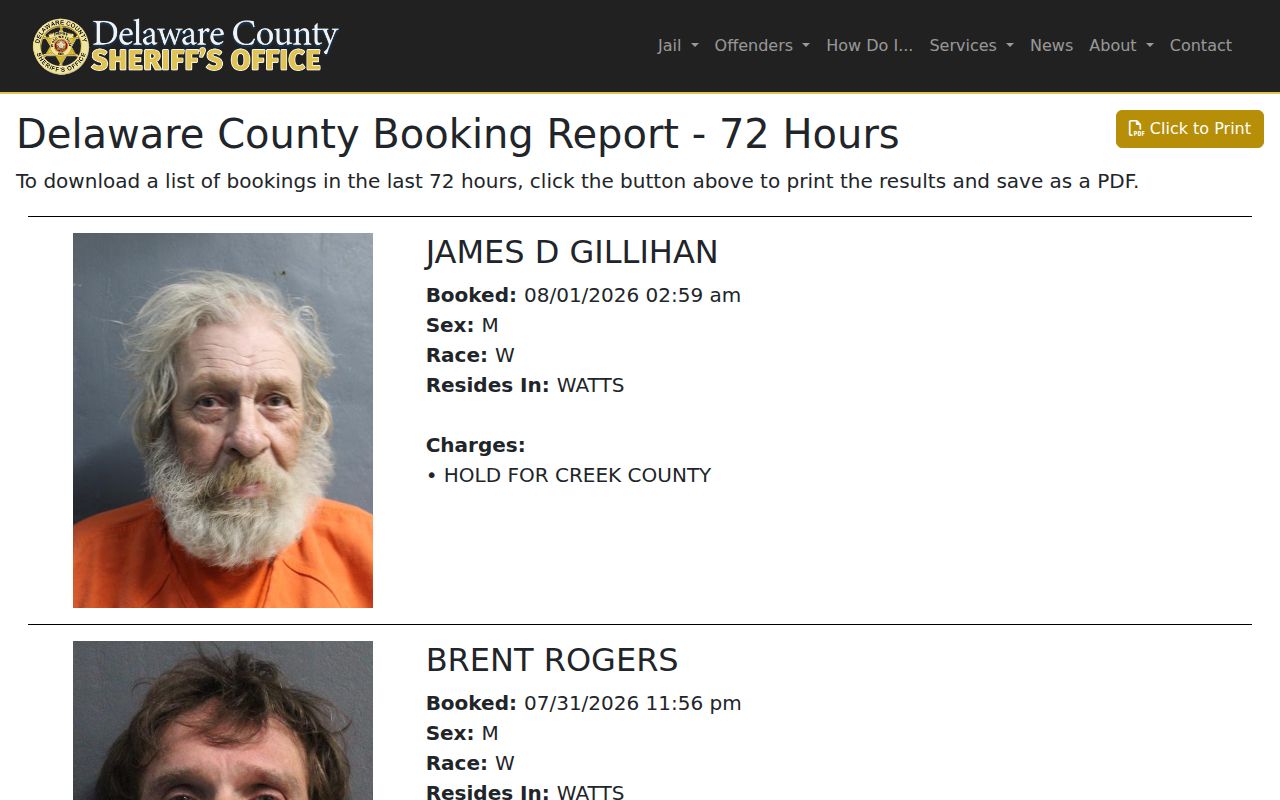
A photograph or booking date on that report proves only that the source associated the person with an arrest and booking context. It does not prove that county custody continued through the capture date, nor that release occurred within the same three-day span. Use the booking number as a lead for the jail-register request.
Note: DCSO also publishes a daily booking report, but neither official booking product is a released-person archive.
Weekend Delaware County Release Checks
A three-day review often covers a Friday-to-Monday period or an office closure. The court clock and jail clock can differ. A judge may sign a bond or release order before jail staff receive it, check other holds, and complete discharge. The court docket can therefore show legal authority on one date while the jail register records the physical custody change later.
No Delaware County policy was verified that promises release on a certain day when processing touches a weekend or holiday. Do not assume an early Friday release, a Monday entry, or a set lag. Call the jail for the live operational answer. Later, request the record that identifies the completed date and manner.
Multiple cases need a hold-by-hold review. Release in one matter does not cancel another warrant, sentence, detainer, or transport order. If the docket shows a dismissal but the person remains on the roster, ask DCSO whether another authority still controls custody.
A VINE event may arrive after the physical move, and a court filing may post on a schedule that differs from jail operations. Preserve the event date as displayed, the reporting agency, and the time of the check. If VINE says released while DCSO still lists the person, call the jail rather than choosing one screen. If VINE says transferred, follow the receiving authority. The three-day window is a way to organize checks, not a promise that all systems update together.
Delaware County Three-Day Status
A wider window can expose a chain of custody. It should not flatten that chain into one release date. Compare each event by source and scope.
| Source result | What it establishes | What it does not establish |
|---|---|---|
| DCSO roster match | Current county listing at the check time. | Exact future release time. |
| DCSO roster miss | No result returned for that search. | Community release. |
| VINE transfer event | Reported movement from one participating custodian. | Freedom from all custody. |
| ODOC active status | State corrections reports an active state episode. | Release from state custody. |
| Court bond or dismissal | Legal action in a case. | Physical discharge time or resolution of other holds. |
| DCSO discharge entry | Date and manner county custody ended. | Status under an unrelated agency. |
If the person entered ODOC, the Delaware County departure was a transfer. If federal facts appear, use the correct federal source. BOP covers federal prison custody, ICE covers a limited immigration-custody window, and USMS has no public person locator. A missing county result is not a reason to imply federal or immigration status.
Municipal arrests create another branch. No single Delaware County municipal release archive was verified. Contact the arresting police department and municipal court when the person was held locally but never booked into DCSO. A later county booking is a second custody episode, so a police release date and county discharge date should not be merged. The last known custodian determines which record can confirm the event.
Request Delaware County Release Proof
For a historical or documentary answer, contact DCSO Records at 327 S. 5th Street, Jay, OK 74346. In-person request hours are weekdays from 9 a.m. to 3 p.m. Ask for the public jail-register entry and any public discharge or release sheet associated with the identified booking. Supply the approximate date and case or booking number so the custodian can isolate the right record.
Request the date and manner of discharge or escape, any public release time, and the receiving authority if the event was a transfer. Ask for an itemized fee estimate and available format before processing. DCSO publishes no fixed response time for this request and no fixed online retention interval.
Records may last after a roster entry disappears. Web visibility and agency retention are separate issues. For older releases, pair the register entry with court filings and ODOC history as needed. If a record is sealed or expunged, acknowledge the access limit and do not reconstruct protected details from stale unofficial copies.
A narrow request improves the chance of locating the right entry without pulling unrelated material. Ask whether inspection is available and distinguish it from receiving copies. If DCSO withholds a portion, request the cited legal basis and ask whether the remaining public material can be separated. Do not promise a set turnaround. Retrieval, review, identity ambiguity, archived media, and lawful redaction can affect processing time.
Note: The Delaware County named-person search explains how to extend a county record check into state, court, and federal systems.