
Federal BOP Release Paths
BOP holds people committed to federal prison sentences. It does not operate the Delaware County Jail, handle ordinary Oklahoma prison custody, or serve as the public locator for all federal pretrial prisoners. A local booking may end in a federal transfer, but the DCSO discharge entry should identify the receiving authority. USMS may control transport or pretrial custody before BOP designation.
After the federal prison term, BOP may display a release date and wording such as “Released” or “Not in BOP Custody.” That confirms only departure from BOP. A person can then be under federal supervision, held by ICE, returned to state or local custody, or transferred through USMS. Community release and movement to another custodian must remain distinct.
| Federal stage | Primary source |
|---|---|
| Federal case and sentence | Federal court docket and filed judgment |
| Pretrial or transport custody | USMS, counsel, court, or named holding facility |
| Federal prison term | BOP Inmate Locator |
| Immigration custody | ICE Online Detainee Locator |
Search Federal BOP Releases
Use the official BOP Inmate Locator. A federal register number is the strongest key. Name searches can also use demographic fields, but similar names require care. Compare the register number, name, age, race, sex, location or status, and displayed release date before treating the result as the correct person.
- Search by register number when it is known.
- Otherwise use the supported name and demographic fields.
- Open the match and preserve the exact release date and location wording.
- Read “Released” or “Not in BOP Custody” only as a BOP result.
- Check the federal docket or next agency when a later handoff is supported.
BOP dates can change through sentence recalculation. A past screenshot does not replace a current check. Record the access time and do not infer why a date moved unless the agency or filed court record explains it.
Federal BOP Locator Fields
The locator returns a narrow set of federal prison fields. They help match identity and describe the BOP episode, but they do not summarize every form of custody. A Delaware County address or arrest history is not enough to establish that a BOP result belongs to the same person.
| Field | How to read it |
|---|---|
| Register number | Primary federal identifier for matching |
| Name and demographics | Supporting identity comparison |
| Release date | BOP's displayed date for the federal prison episode |
| Location or status | Current BOP placement or released wording |
“Not in BOP Custody” does not say where the person is. It may reflect release, movement, or a person outside BOP's current control. Use the federal case, known facility, counsel, or relevant agency to resolve the next stage.
Federal BOP Records Contact
BOP's locator is the public search route documented by the research. For a record question beyond the locator, use official BOP channels and identify the register number, sentencing court, and relevant date. If the person has not yet been designated to BOP, contact the federal court, counsel, USMS district office, or holding facility instead.
Federal Bureau of Prisons System
Public lookup: BOP Inmate Locator
Best identifier: federal register number
Local facility: no BOP institution verified in Delaware County
Pretrial route: USMS Northern District of Oklahoma, 918-200-0600
The Northern District USMS custody page covers the gap before BOP designation and federal transport. USMS has no general public person locator, so a BOP no-result cannot be treated as a release finding.
Federal Release Record Meaning
A useful federal release record answers which federal sentence was involved, which register number identifies the person, what date BOP displays, and whether another authority received custody. The federal court judgment explains the imposed sentence. BOP administers the prison term and locator status. Supervised release is a court-ordered period in the community after confinement and is not BOP incarceration.
- Federal register number
- The identifier used to distinguish federal prisoner records.
- Supervised release
- Court-ordered community supervision after a federal prison term.
- Detainer
- A notice that another authority may seek custody.
- Discharge
- Completion of the obligation described by the source record.
If BOP says released while another source shows custody, report both episodes with labels. Do not force them into one status. The later custodian controls the current physical-custody question.
ICE After a Federal Release
A BOP departure can be followed by ICE custody. If the federal docket, BOP information, USMS, or another source supports that handoff, search the ICE detainee locator. It covers current ICE detention and people released from ICE custody within the prior 60 days. A current ICE match means the BOP release was not community release.
The systems use different identity fields and legal authority. BOP concerns criminal federal imprisonment. ICE detention is civil immigration custody. Do not infer immigration status from a BOP result or from absence in one locator. After ICE's online window, the Detention Reporting and Information Line is 888-351-4024.
Delaware County Federal Transfers
A Delaware County Jail departure can lead to federal custody. Start with DCSO's discharge record and ask whether another authority accepted the person. If USMS was the receiving authority, use the federal case and district contact. BOP becomes the right locator after designation to a federal sentence. This sequence prevents a county transfer from being labeled a community release.
No BOP prison was verified in Delaware County. A resident can be held far outside the county because federal placement is not based on county borders alone. The Delaware County release search covers the local jail-register request that establishes the first handoff.
Note: Geography does not choose the locator; the authority controlling the specific custody episode does.
Verify Federal Release Conflicts
When records conflict, compare their scope and access time. A court docket may show the legal sentence but not the physical gate event. BOP may show the federal prison release but not ICE or state custody. USMS may hold a person outside BOP before trial or during transport. Each can be correct about a different stage.
Match by register number where possible. Preserve the exact BOP date and location wording. Ask the source agency about a date change rather than offering a cause. A no-result is not proof that a person was released, never entered federal custody, or is free of another hold.
The official BOP locator shown below demonstrates the correct federal search channel.
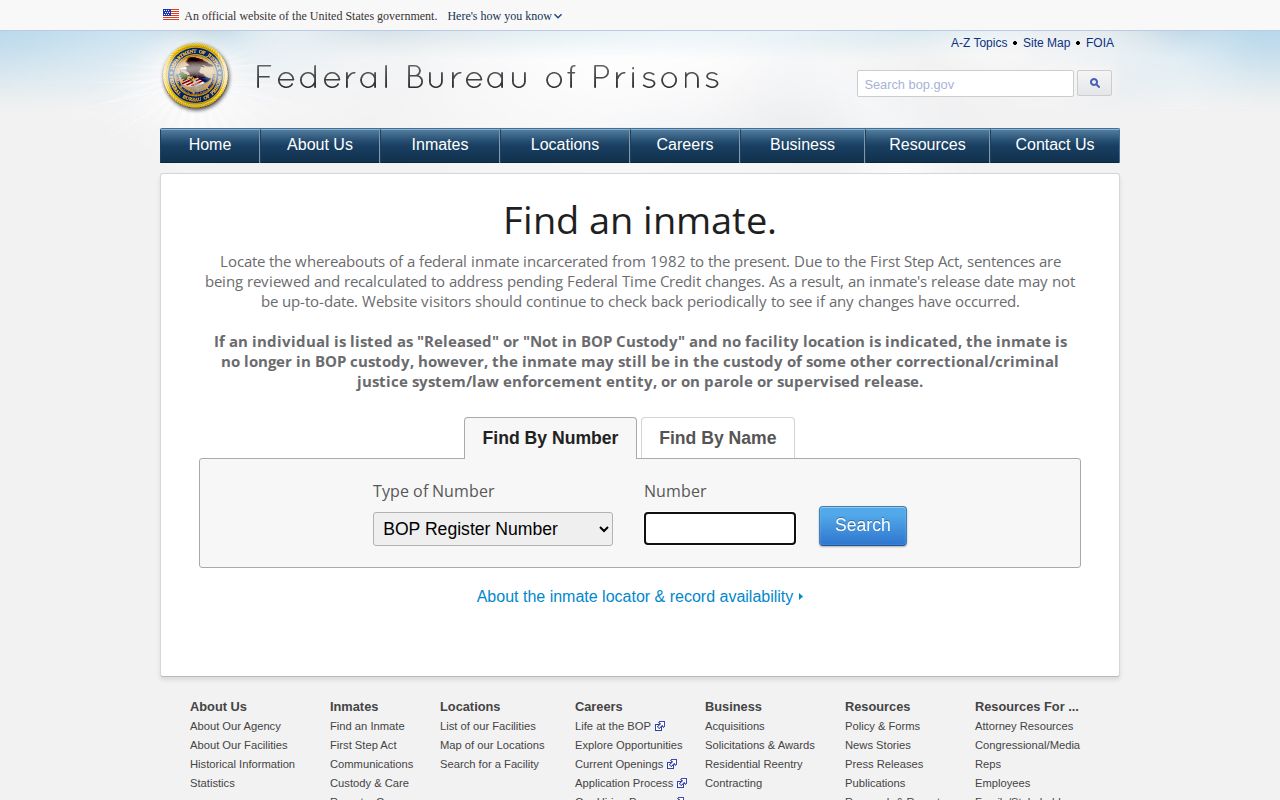
The live result, not the image alone, supplies the current federal status and release date.
Federal BOP Historical Release Proof
For an older federal prison release, save the live BOP locator result and locate the federal docket around the displayed date. Review filed judgment, release, and supervision documents instead of relying on a short docket caption. The judgment states the term imposed. BOP calculates and administers the prison term, so its displayed date can change through recalculation. If an old estimate and current result differ, preserve both and ask BOP about the official prison record.
If another agency accepted custody, seek the public movement or receiving record from that source. A BOP result is strong evidence for the federal prison episode, but the next system must document what happened after BOP control ended. An ICE record may show civil detention. A state or county record may show a separate hold. Federal supervised release is a court-ordered community status, not continued BOP incarceration.
Identity conflicts must be resolved before status is interpreted. Federal register numbers are more reliable than names. Compare the number, age, and other displayed fields, then connect the result to the sentencing court. A person with the same name but a different identifier must not be merged with a Delaware County case. If the match remains uncertain, state that no match was confirmed and contact the agency.
BOP Designation After USMS Custody
When a local discharge record names USMS rather than BOP, begin with the Northern District office and the federal case. A person awaiting trial or transport may be housed at a partner facility without appearing as a current BOP prisoner. After sentence, designation can take time. The federal case number, register number when assigned, and named holding facility form the strongest chain across that transition.
A no-result during this stage is not a release. Ask whether USMS still controls transport, whether a detention facility holds the person, or whether BOP designation is pending. Once the locator displays a match, preserve the precise facility or status text. Do not backdate BOP custody to the Delaware County jail departure without a source that connects the two events.
Federal Sentence Date Changes
BOP warns that release dates can change. A court modification, sentence credit, later term, or recalculation may affect the displayed result, but the public should not choose an explanation without a record. Gather the judgment, later orders, register number, and current locator result. Ask the agency which date controls. This evidence-based route avoids turning a prior screenshot or a hand calculation into a false completed-release claim.
Public Record Search
Sponsored Results